
Why boring technology is the right choice for most startups
Chasing the newest framework is tempting. Here is why proven, dull technology will serve your startup better than anything on the cutting edge.
Posts are currently in English. Reach out if you’d like a topic covered in Spanish.
Every few months a new framework, runtime, or database lands on Hacker News and the cycle repeats: benchmarks are posted, Twitter threads are written, and engineering teams start asking whether they should rewrite their stack.
Most of the time, the answer is no.
The real cost of novelty
New technology carries hidden costs that rarely appear in the benchmark post. Documentation is sparse and often wrong. The community is small, so Stack Overflow won’t save you at 2am. The hiring pool is tiny. The edge cases haven’t been discovered yet, by anyone.
For a startup, these costs are catastrophic. You are not building a demo. You are building something that has to work reliably, be understood by whoever joins next, and survive the inevitable emergency at the worst possible moment.
Boring is fast
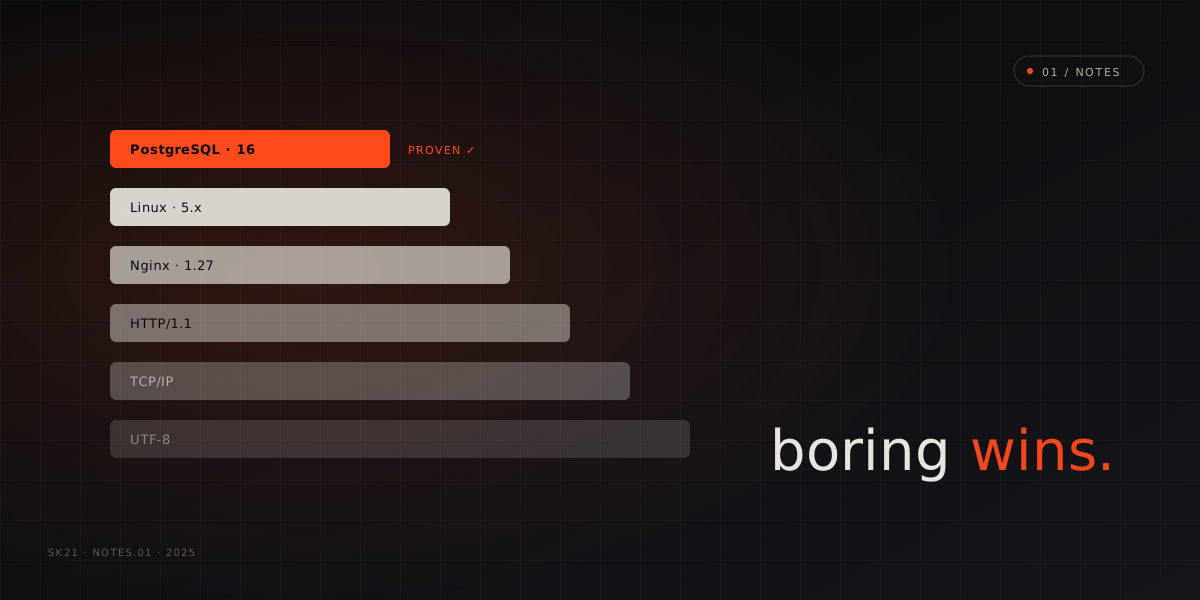
This sounds counterintuitive, but boring technology lets you move faster. When you reach for PostgreSQL instead of the hot new distributed database, you get:
- Years of battle tested defaults
- Answers to almost every question you’ll have
- Engineers who already know it
- A deep ecosystem of tooling and integrations
Speed comes from spending your cognitive budget on the problem you’re solving, not on the infrastructure you’re running.
When new technology is the right call
There are legitimate reasons to reach for something newer:
- The established option genuinely cannot solve your problem (rare)
- The new tool has become the clear standard in a specific domain (e.g. Kafka for high throughput event streaming)
- You have the expertise in house to absorb the risk
The key question isn’t “is this exciting?” It’s “can we own this when it breaks?”
A practical heuristic
If you can’t find a postmortem from a company running this technology in production at your scale, you’re the pioneer. Sometimes that’s fine. Usually it isn’t worth it.
Pick the tool your team knows, that has a large community, and that will still be maintained in five years. Ship the product. The technology is not the product.